Alisa Menshikova
12th January 2022
REPRESENTATION
OF THE UNSPEAKABLE
IN PAINTINGS
OF LUC TUYMANS
OF THE UNSPEAKABLE
IN PAINTINGS
OF LUC TUYMANS
This essay analyses how the concept of the Unspeakable in the understanding of Naomi Mandel can be applied to three Holocaust-related paintings of Luc Tuymans: An Architect (1998), Gas Chamber (1986) and Recherches No. 1 (1989). To execute the analysis, the Unspeakable was presented in its manifestations of Limits of Knowledge: Silence, Absence and Impossibility, and the paintings were presented through their formal elements: titles, subject matters, colours and the level of detailing. The analysis showed that Luc Tuymans’ artistic style and approach follows the path of representing the Holocaust as the Unspeakable, critisized by Naomi Mandel.
Abstract
Theoretical Background
The origins of the Unspeakable concept in relation to the Holocaust could be traced to 1943 Himmler’s speech:
but in public we will never speak of it. I am referring to the evacuation of the Jews, the annihilation of the Jewish people. [...]
In our history, this is an unwritten and never-to-be-written page of glory (Trezise, 2001),
given to SS officers. In the broader sense, this message, together with the shame, haunting perpetrators after the War on the one hand, and the trauma, which made the victims unable to talk about the Event on the other hand, caused the societal condition, which then was conceptualised as the Unspeakable.
One of the first important contributions to the theoretical field of the Shoah’s understanding was done by Theodor Adorno in 1949 with the maxima ‘‘To write poetry after Auschwitz is barbaric’’ (Adorno, 1955). Being said by the famous German philosopher, this phrase had a huge impact on a field and generated a whole lot of responses and debates, which are still going on even 80 years after the beginning of WWII. Despite the fact that the correctly translated phrase does not necessarily mean that Auschwitz/Holocaust could not be spoken about, the most distributed reading “poetry is impossible after Auschwitz” (Rowland, 1997), already contains the Unspeakable and works as a promotion of this idea.
More recent example of the discussion around this concept is Thomas Trezise’s essay “Unspeakable”, in which he distinguishes four dictionary meanings of this word and applies them to the world after the Holocaust (Trezise, 2001). The first one is a linguistic meaning, which cannot be fully applied to the Event, because the society had already produced a great amount of texts devoted to it, thus there is a vocabulary relevant to describing and/or discussing it (Trezise, 2001). The second one is a normative meaning, which marks the subject of the Unspeakable as something inexpressibly bad, and the Holocaust as the process of killing millions of people fits into this meaning (Trezise, 2001). The third one is a prescriptive meaning, which connects with the process of perception of the Holocaust as the sacred event, which thus should not be spoken about (Trezise, 2001). And the last one is a subjective meaning, referring to the survivors’ inability or unwillingness to speak about the Event, as a result of their trauma (Trezise, 2001).
The other recent work on this theme is Naomi Mandel’s article “Rethinking ‘After Auschwitz’: Against a Rhetoric of the Unspeakable in Holocaust Writing” (Mandel, 2001). Mandel critisizes the concept of the Unspeakable in general, explaining, how victims’ traumatic inability to speak transformed into societal taboos, and how together with making the Event sacred, it gradually leads to the forgetting and erasing of the reasons of the Holocaust (Mandel, 2001). These ideas intersect with subjective and normative meanings of the Unspeakable, mentioned in Trezise’s text (2001). Beyond that, Mandel writes about the manifestations of the Unspeakable (Mandel, 2001). The first one, standing aside, is complicity (Mandel, 2001). It can hardly be applied to the artworks in general and Tuymans’ paintings in particular, so it isn’t used in further analysis. All the other manifestations Mandel unites in already mentioned Limits of Knowledge: Absence (of survivors and witnesses), Silence (of survivors, witnesses, perpetrators and the society), and Impossibility (to understand the knowledge of victims) (Mandel, 2001). She distinguishes these factors from the general rhetoric of the Unspeakable to show what kind of things the society need to fight in order to not forget and not repeat the Holocaust (Mandel, 2001).
Concept of the Unspeakable in relation to Tuymans’ works was already tangentially discussed in Ronan McKinney’s article “Luc Tuymans’ StillLife and the monstration of 9/11” (2014), and in Lawrence Rinder’s essay “Tuymans’ Terror” (1997). However, it had not been applied to Tuymans’ Holocaust-related works yet.
Tuymans has a few works, devoted to the Holocaust. All of them are stingy on colours and details, but this essay would examine three of them in depth: An Architect (1998); Gas Chamber (1986); and Recherches No. 1 (1989). Chosen works have both similarities, like restricted colour palettes and photo references as the basis, and differences, like subject matters, genres and hues, which allows the analysis to cover different aspects of the works. Besides that, listed works were produced in early years of Tuymans’ career. It was important to include An Architect (1998) produced in the late-nineties to analyse Tuymans’ attitude towards painting people, because for the younger Tuymans it was not characteristic in general. But the time span between Gas Chamber (1986) and An Architect (1998) is only 12 years, so they still could be attributed to the same period of artist’s practice.
but in public we will never speak of it. I am referring to the evacuation of the Jews, the annihilation of the Jewish people. [...]
In our history, this is an unwritten and never-to-be-written page of glory (Trezise, 2001),
given to SS officers. In the broader sense, this message, together with the shame, haunting perpetrators after the War on the one hand, and the trauma, which made the victims unable to talk about the Event on the other hand, caused the societal condition, which then was conceptualised as the Unspeakable.
One of the first important contributions to the theoretical field of the Shoah’s understanding was done by Theodor Adorno in 1949 with the maxima ‘‘To write poetry after Auschwitz is barbaric’’ (Adorno, 1955). Being said by the famous German philosopher, this phrase had a huge impact on a field and generated a whole lot of responses and debates, which are still going on even 80 years after the beginning of WWII. Despite the fact that the correctly translated phrase does not necessarily mean that Auschwitz/Holocaust could not be spoken about, the most distributed reading “poetry is impossible after Auschwitz” (Rowland, 1997), already contains the Unspeakable and works as a promotion of this idea.
More recent example of the discussion around this concept is Thomas Trezise’s essay “Unspeakable”, in which he distinguishes four dictionary meanings of this word and applies them to the world after the Holocaust (Trezise, 2001). The first one is a linguistic meaning, which cannot be fully applied to the Event, because the society had already produced a great amount of texts devoted to it, thus there is a vocabulary relevant to describing and/or discussing it (Trezise, 2001). The second one is a normative meaning, which marks the subject of the Unspeakable as something inexpressibly bad, and the Holocaust as the process of killing millions of people fits into this meaning (Trezise, 2001). The third one is a prescriptive meaning, which connects with the process of perception of the Holocaust as the sacred event, which thus should not be spoken about (Trezise, 2001). And the last one is a subjective meaning, referring to the survivors’ inability or unwillingness to speak about the Event, as a result of their trauma (Trezise, 2001).
The other recent work on this theme is Naomi Mandel’s article “Rethinking ‘After Auschwitz’: Against a Rhetoric of the Unspeakable in Holocaust Writing” (Mandel, 2001). Mandel critisizes the concept of the Unspeakable in general, explaining, how victims’ traumatic inability to speak transformed into societal taboos, and how together with making the Event sacred, it gradually leads to the forgetting and erasing of the reasons of the Holocaust (Mandel, 2001). These ideas intersect with subjective and normative meanings of the Unspeakable, mentioned in Trezise’s text (2001). Beyond that, Mandel writes about the manifestations of the Unspeakable (Mandel, 2001). The first one, standing aside, is complicity (Mandel, 2001). It can hardly be applied to the artworks in general and Tuymans’ paintings in particular, so it isn’t used in further analysis. All the other manifestations Mandel unites in already mentioned Limits of Knowledge: Absence (of survivors and witnesses), Silence (of survivors, witnesses, perpetrators and the society), and Impossibility (to understand the knowledge of victims) (Mandel, 2001). She distinguishes these factors from the general rhetoric of the Unspeakable to show what kind of things the society need to fight in order to not forget and not repeat the Holocaust (Mandel, 2001).
Concept of the Unspeakable in relation to Tuymans’ works was already tangentially discussed in Ronan McKinney’s article “Luc Tuymans’ StillLife and the monstration of 9/11” (2014), and in Lawrence Rinder’s essay “Tuymans’ Terror” (1997). However, it had not been applied to Tuymans’ Holocaust-related works yet.
Tuymans has a few works, devoted to the Holocaust. All of them are stingy on colours and details, but this essay would examine three of them in depth: An Architect (1998); Gas Chamber (1986); and Recherches No. 1 (1989). Chosen works have both similarities, like restricted colour palettes and photo references as the basis, and differences, like subject matters, genres and hues, which allows the analysis to cover different aspects of the works. Besides that, listed works were produced in early years of Tuymans’ career. It was important to include An Architect (1998) produced in the late-nineties to analyse Tuymans’ attitude towards painting people, because for the younger Tuymans it was not characteristic in general. But the time span between Gas Chamber (1986) and An Architect (1998) is only 12 years, so they still could be attributed to the same period of artist’s practice.
Introduction
Luc Tuymans is a Belgian (Flemish) artist born in 1958. Tuymans is famous for paintings, embodying history, politics and media as their main subjects. Tuymans, as a descendant of both Dutch resistance members and Flemish collaborators, took the subject of World War II, the Holocaust and the Third Reich as one of the main themes, unfolding throughout his career, and by 2019 had produced more than 14 paintings referring to this subject (Ruiz, 2019).
This essay would focus mainly on three of his works:
An Architect (1998); Gas Chamber (1986); and Recherches No. 1 (1989),
This essay would focus mainly on three of his works:
An Architect (1998); Gas Chamber (1986); and Recherches No. 1 (1989),
exploring, how the formal elements of these paintings could reflect different interpretations of the Unspeakable concept, which often appears in Holocaust studies, and is considered an important characteristic of the Event. General framework of this essay would lean on Naomi Mandel’s concept of Limits of Knowledge, which she qualifies as manifestations of the Unspeakable in regard to the Holocaust. Limits consist of Absence, Silence and Impossibility. So, the formal elements of Tuymans’ paintings would be compared with those three concepts.
Chapter 1: Formal elements
Chapter 1: Formal elements
as Limits of Knowledge will outline connections between formal elements and particular Limits of Knowledge and provide more relatable concepts which will be applied to Tuymans’ works along the essay. Chapter 2: Con(text) will spot how the relation between titles and artworks reflects the concept of Impossibility and Silence. Chapter 3: Subject matter will show how the choice of the depicted object can comment on the Absence. Chapter 4: Colour will connect colour palettes with the ideas of Silence and Absence. And Chapter 5: Detailing will reflect on the lack of details as an expression of Impossibility.
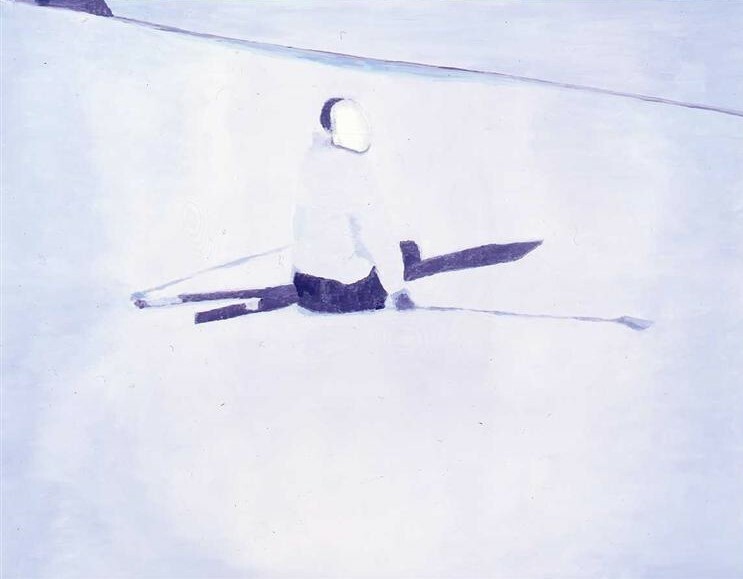
An Architect (Tuymans, 1998) depicts the Minister of Armaments and War Production of the Third Reich - Albert Speer on a ski resort. The photo, which the artist used as a reference, was taken by Speer’s wife (Tate, 2004).
TUYMANS, L. (1998). An Architect, [Oil on canvas], 113cm x 144cm
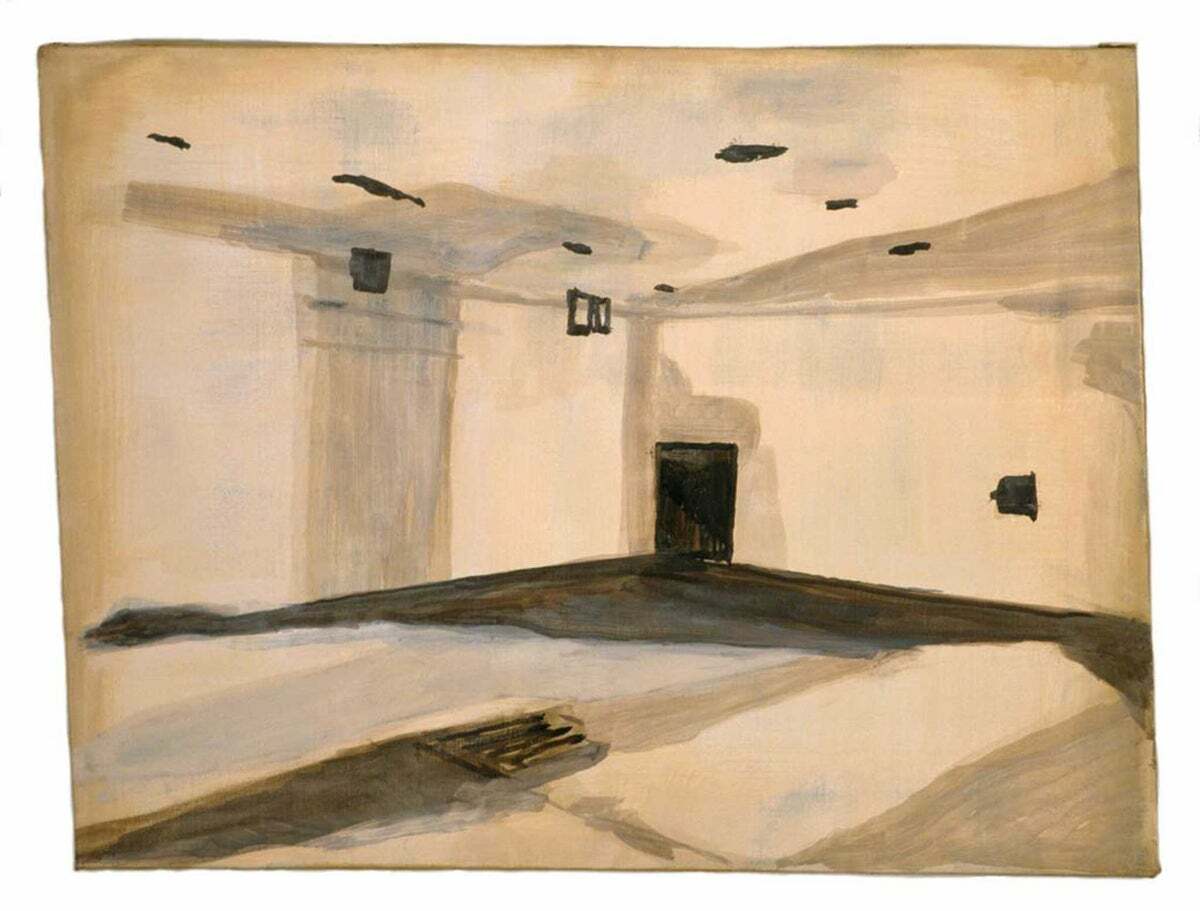
Gas Chamber (Tuymans, 1986) shows an interior of a gas chamber in Auschwitz camp, which Tuymans had visited himself as a museum (Loock, 2003, p.55).
TUYMANS, L. (1986). Gas Chamber, [Oil on canvas], 50cm x 70cm, Private Collection.
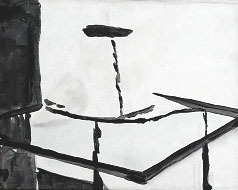
Recherches No. 1 (Tuymans, 1989) is a part of a triptych, presenting seemingly-innocuous parts of the interior, but actually showing the horrors of Auschwitz camp. First in the series, the painting depicts the lampshade, made out of human skin (Tate, 2004).
TUYMANS, L. (1989). Recherches No. 1, [Oil on canvas], 36,5cm x 44,5cm, Private Collection.
Chapter 1: Formal elements
as Limits of Knowledge
as Limits of Knowledge
This essay will provide the analysis of Tuymans’ works from the perspective of formal elements, such as: relations between titles and works, detailing, colour palette and the subject matter. These formal elements would be addressed in relation to Naomi Mandel’s Limits of Knowledge, which she sees as manifestations of the Unspeakable: Absence, Silence and Impossibility (Mandel, 2001).
Lack of details together with the lack of colour, which are generally characterising for Tuymans’ paintings, could serve as visual equivalents or expressions of Silence. This statement can be confirmed with Trezise’s idea that «the artistic representation of the Holocaust constitutes the indictment of a certain silence» (Trezise, 2001, p. 46). At the same time, poor detailing can refer to the Impossibility of reaching the knowledge/the scene. Absence could be connected with the absence of certain scenes and motives in the artist’s work, e.g. lack of people or non-representation of victims. This example refers to Trezise’s prescriptive meaning of the Unspeakable - victims should not be depicted, because they are dead or/and martyrs. Although it should be noted that Tuymans depicts perpetrators: besides An Architect (1998), he has a number of paintings showing the top figures of the Third Reich, like Himmler (1998) and Secrets (1990). This inconsistency creates a tension and makes the understanding of the Absence concept more complicated.
Besides presenting the Limits of Knowledge, Mandel states that “contemporary culture maintains its position as safely distant, conceptually and ethically, from this ‘unspeakable’ event” (Mandel, 2001, p.224). This distance is an important characteristic of Tuymans works, and is constructed both through the same formal elements, like muted colour palette and lack of details, and the fact that Tuymans uses photographic references for his works. As McCrickard writes, Tuymans’ urge to ‘put physical distance between his eye and hand’ leads to creating a ‘psychological barrier between image, artist and viewer’ (McCrickard, 2015). Photography on its own is a distance-creating phenomenon, but the source of those photographs - often mass media, e.g. TV or newspapers, makes the distance even bigger, because mass produced images, which barely have any particular addressee or source, do not carry personal relations anymore.
Additionally, Tuymans’ works could be analysed through the perspective of Ruth Wajnryb. In her article The Holocaust as Unspeakable: Public Ritual Versus Private Hell, she examines the reasons of the survivors to not talk about their experience, e.g. fear of traumatising people and the difference between knowledge and experience of the speaker and the audience (Wajnryb, 1999). Generally, she proposes that the society had cultivated the language to talk about the Holocaust based on the rules, initially developed by and for survivors to cope with their trauma (Wajnryb, 1999). She describes this language as detached, indirect and tuned down. These characteristics again could refer to Tuymans not showing the details and not depicting actual/visible horrors of camps, masking these horrors.
Lack of details together with the lack of colour, which are generally characterising for Tuymans’ paintings, could serve as visual equivalents or expressions of Silence. This statement can be confirmed with Trezise’s idea that «the artistic representation of the Holocaust constitutes the indictment of a certain silence» (Trezise, 2001, p. 46). At the same time, poor detailing can refer to the Impossibility of reaching the knowledge/the scene. Absence could be connected with the absence of certain scenes and motives in the artist’s work, e.g. lack of people or non-representation of victims. This example refers to Trezise’s prescriptive meaning of the Unspeakable - victims should not be depicted, because they are dead or/and martyrs. Although it should be noted that Tuymans depicts perpetrators: besides An Architect (1998), he has a number of paintings showing the top figures of the Third Reich, like Himmler (1998) and Secrets (1990). This inconsistency creates a tension and makes the understanding of the Absence concept more complicated.
Besides presenting the Limits of Knowledge, Mandel states that “contemporary culture maintains its position as safely distant, conceptually and ethically, from this ‘unspeakable’ event” (Mandel, 2001, p.224). This distance is an important characteristic of Tuymans works, and is constructed both through the same formal elements, like muted colour palette and lack of details, and the fact that Tuymans uses photographic references for his works. As McCrickard writes, Tuymans’ urge to ‘put physical distance between his eye and hand’ leads to creating a ‘psychological barrier between image, artist and viewer’ (McCrickard, 2015). Photography on its own is a distance-creating phenomenon, but the source of those photographs - often mass media, e.g. TV or newspapers, makes the distance even bigger, because mass produced images, which barely have any particular addressee or source, do not carry personal relations anymore.
Additionally, Tuymans’ works could be analysed through the perspective of Ruth Wajnryb. In her article The Holocaust as Unspeakable: Public Ritual Versus Private Hell, she examines the reasons of the survivors to not talk about their experience, e.g. fear of traumatising people and the difference between knowledge and experience of the speaker and the audience (Wajnryb, 1999). Generally, she proposes that the society had cultivated the language to talk about the Holocaust based on the rules, initially developed by and for survivors to cope with their trauma (Wajnryb, 1999). She describes this language as detached, indirect and tuned down. These characteristics again could refer to Tuymans not showing the details and not depicting actual/visible horrors of camps, masking these horrors.
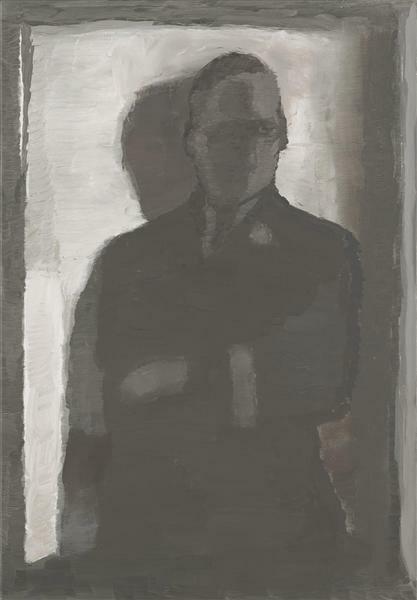
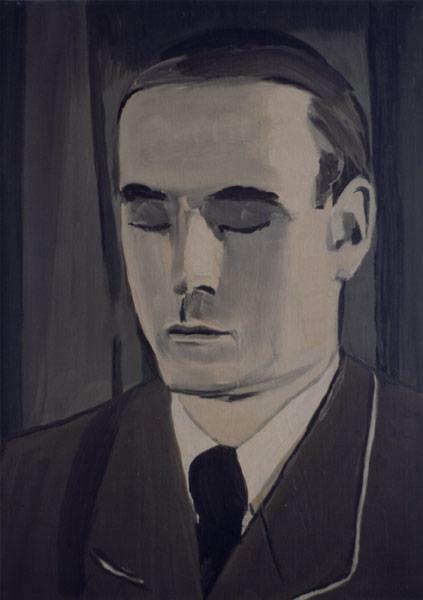
TUYMANS, L. (1990). Secrets, [Oil on canvas], 52cm x 37cm, Private Collection.
TUYMANS, L. (1998). Himmler, [Oil on canvas], 51.5cm x 36cm
Chapter 2: Con(text)
The first two interconnected things embodying the Limits of Knowledge in Tuymans’ works are things prior to the appearance of the paintings themselves. These are the context and the titles. The relations between these two things and the actual canvases reflect how depicting something does not necessarily lead to speaking about it.
Gas Chamber (1986) is one of the very few Tuymans’ Holocaust-related works, which has a speaking title, and does not demand any additional knowledge about the subject. Tuymans himself describes Gas Chamber (1986) as a “work that might look warm, but when you read the title it becomes threatening, the whole image changes” (Tuymans, 2003, p.20). In this case, the process of understanding the work by the viewer is shortened in time, the only gap implied by Tuymans is inability to read the image on itself and understand its meaning. So, the distance between the viewer and the knowledge is not that large.
Loock, in his chapter of the book about Luc Tuymans, examined the work Schwarzheide (1986). This is one of the earliest Tuymans’ works on this theme, which employs the different visual language and different type of reference: Schwarzheide (1986) was based on the postcard from the museum and the anecdote behind it, almost a myth, when the majority of other Holocaust-related Tuymans’ works were based on the photographs. Loock, writing about this painting stated that its title provides some glimpse to the meaning, but as long as Schwarzheide is not the most well-known camp, and it is not possible to understand the work without knowing the whole story about prisoners cutting images in the camp to reassemble them after the release, it aims at the “extraordinarily knowledgeable viewer” (Loock, 2003, p.48), and this statement is equally actual for An Architect (1998) and Recherches No.1 (1989).
Gas Chamber (1986) is one of the very few Tuymans’ Holocaust-related works, which has a speaking title, and does not demand any additional knowledge about the subject. Tuymans himself describes Gas Chamber (1986) as a “work that might look warm, but when you read the title it becomes threatening, the whole image changes” (Tuymans, 2003, p.20). In this case, the process of understanding the work by the viewer is shortened in time, the only gap implied by Tuymans is inability to read the image on itself and understand its meaning. So, the distance between the viewer and the knowledge is not that large.
Loock, in his chapter of the book about Luc Tuymans, examined the work Schwarzheide (1986). This is one of the earliest Tuymans’ works on this theme, which employs the different visual language and different type of reference: Schwarzheide (1986) was based on the postcard from the museum and the anecdote behind it, almost a myth, when the majority of other Holocaust-related Tuymans’ works were based on the photographs. Loock, writing about this painting stated that its title provides some glimpse to the meaning, but as long as Schwarzheide is not the most well-known camp, and it is not possible to understand the work without knowing the whole story about prisoners cutting images in the camp to reassemble them after the release, it aims at the “extraordinarily knowledgeable viewer” (Loock, 2003, p.48), and this statement is equally actual for An Architect (1998) and Recherches No.1 (1989).
TUYMANS, L. (1990). Secrets, [Oil on canvas], 52cm x 37cm, Private Collection.
Chapter 3:
Subject matter
Subject matter
So, An Architect (Tuymans, 1998) and Recherches No.1 (Tuymans, 1989) have different textual-visual relations than Gas Chamber (Tuymans, 1986). By knowing only the image and the title, the viewer does not get the whole context. So, if these are presented without artistic or curatorial accompanying text, the meanings of the images are not to be unfolded at all. This works as an enlargement of the distance between the viewer and the work, and consequently, the viewer and the knowledge. These relations, set by Tuymans, work towards the impossibility of the viewer to gain some knowledge about the Holocaust and the silencing of the subject. Tuymans’ point of view on the silencing is disclosed in this quote:
Tuymans speaks of this necessity of disguising objects which evade representation, as that “which is absolutely inaccessible if it is not disguised” [Loock, (1996), p.51]: disguising something is thus, paradoxically, a way of showing it. This paradox can be explained by understanding this strategy of hiding as having a certain micro-political import: the tendency to hide something with the purpose of transgressing it (Mieves, 2013, p. 300).
This artistic approach can be defined as the one, preceding to the Holocaust and the silence, accompanying it in the second half of the XX century. However, applied to this theme it responds to and follows the societal taboos, destructive for the memory about the Event.
So, through not unfolding the story in the titles, and giving the viewers only glimpses of the meanings, Tuymans’ works embody Silence - as a “state of refusing to talk about something or answer questions, or a state of not communicating” (Cambridge Advanced Learner’s Dictionary & Thesaurus) and Impossibility to understand what the work is about without any additional knowledge or information.
Tuymans speaks of this necessity of disguising objects which evade representation, as that “which is absolutely inaccessible if it is not disguised” [Loock, (1996), p.51]: disguising something is thus, paradoxically, a way of showing it. This paradox can be explained by understanding this strategy of hiding as having a certain micro-political import: the tendency to hide something with the purpose of transgressing it (Mieves, 2013, p. 300).
This artistic approach can be defined as the one, preceding to the Holocaust and the silence, accompanying it in the second half of the XX century. However, applied to this theme it responds to and follows the societal taboos, destructive for the memory about the Event.
So, through not unfolding the story in the titles, and giving the viewers only glimpses of the meanings, Tuymans’ works embody Silence - as a “state of refusing to talk about something or answer questions, or a state of not communicating” (Cambridge Advanced Learner’s Dictionary & Thesaurus) and Impossibility to understand what the work is about without any additional knowledge or information.
The presence and the absence of certain themes inside the general area of Holocaust-related paintings can reflect both Silence - if observed from the painter’s point of view, and Absence - if observed from the viewer’s perspective.
The most common subjects of Tuymans’ works, and his paintings about the Holocaust in particular, are uninhabited interiors, uncertain or/and unrecognizable objects, faceless people. Loock writes about one of the first Tuymans’ exhibitions, exposing among others Gas Chamber (1986): “Almost all the works show pictures of spaces structuring states of existence. They are pictures of empty rooms, of isolated things, pictures of a world that is frozen beneath the gaze, shattered, deathly still” (Loock, 2003, p.56). He proposes that these things reflect Tuymans’ mourning (Loock, 2003, p.57).
Naomi Mandel in her article describes visual images the society associates with the Holocaust: “a train station, cattle cars, bewildered naked people, some go to the right, some go to the left, gas, ovens, chimney, smoke”, and analyses how the great tragedy of millions of people was reduced mostly to some objects (Mandel, 2001, p.204). Tuymans’ Holocaust-related paintings are the examples of this reduction. The artist had not abused the most distributed images of chimneys, camps or train stations, though he had painted an interior of a gas chamber, which due to the lack of details at first is not usually recognized as such. Gas Chamber (1986) generally could serve as an example of absence/presence dichotomy: the empty room even without the context is perceived by the viewer as lacking a body - there should be someone or something, the viewer feels the Absence, which is according to Mandel is a direct reflection of the Unspeakable (Mandel, 2001). Because of the skin-tone colours of the painting, and the lack of details, the room can be equated to the naked body on its own.
In Recherches No.1 (1989) the depicted, but not fully recognizable object, presents a lampshade made out of human skin. SS officers in Buchenwald reduced human life to the lampshade, making an object out of the subject, human, person. Tuymans in a way repeats/recreates/continues the reduction Mandel (2001)
The most common subjects of Tuymans’ works, and his paintings about the Holocaust in particular, are uninhabited interiors, uncertain or/and unrecognizable objects, faceless people. Loock writes about one of the first Tuymans’ exhibitions, exposing among others Gas Chamber (1986): “Almost all the works show pictures of spaces structuring states of existence. They are pictures of empty rooms, of isolated things, pictures of a world that is frozen beneath the gaze, shattered, deathly still” (Loock, 2003, p.56). He proposes that these things reflect Tuymans’ mourning (Loock, 2003, p.57).
Naomi Mandel in her article describes visual images the society associates with the Holocaust: “a train station, cattle cars, bewildered naked people, some go to the right, some go to the left, gas, ovens, chimney, smoke”, and analyses how the great tragedy of millions of people was reduced mostly to some objects (Mandel, 2001, p.204). Tuymans’ Holocaust-related paintings are the examples of this reduction. The artist had not abused the most distributed images of chimneys, camps or train stations, though he had painted an interior of a gas chamber, which due to the lack of details at first is not usually recognized as such. Gas Chamber (1986) generally could serve as an example of absence/presence dichotomy: the empty room even without the context is perceived by the viewer as lacking a body - there should be someone or something, the viewer feels the Absence, which is according to Mandel is a direct reflection of the Unspeakable (Mandel, 2001). Because of the skin-tone colours of the painting, and the lack of details, the room can be equated to the naked body on its own.
In Recherches No.1 (1989) the depicted, but not fully recognizable object, presents a lampshade made out of human skin. SS officers in Buchenwald reduced human life to the lampshade, making an object out of the subject, human, person. Tuymans in a way repeats/recreates/continues the reduction Mandel (2001)
Chapter 4: Colour
described, by not representing victims of the Holocaust, but painting the objects. He shows only a barely-recognizable object, depriving it of a proper title, and reflecting Mandel’s understanding of Silence by it (2001). Recherches No.1 (1989), with the depiction of the human skin-made object serves as a representation of the absence/presence dichotomy, as well as the image of a gas chamber. If in the case with Gas Chamber (1986), the absence is factual - there is nothing and nobody in the scene, and the presence is metaphorical, transmitted via the skin-tone colour of the painting, Recherches No.1 (1989) shows the actual presence of an object, that used to be a subject, and the absence here is not factual, it is the absence of something intangible: the subjectness and the life. Recherches No.1 (1989) and the depicted lamp could serve as illustrations of the definition of Absence as “a lack of existence” (Cambridge Academic Content Dictionary).
Generally, early works of Tuymans show the horror “devoid of people” (Loock, 2003, p.58), as he mostly depicts inanimate objects. That is why An Architect (1998), depicting Albert Speer, Third Reich’s Minister of Armaments and War Production, shows the shift in Tuymans’ understanding and approach towards the depiction of horrors. Firstly, Tuymans starts producing non-related to Holocaust portraits of people who recall wax figures, dolls, manekens, etc., playing with subject-object dichotomy and eeriness of the uncanny valley. And then, by placing perpetrators’ portraits in a range of painted objects and portraits of non-alive, non-real human-like figures, Tuymans objectifies those, denying their subjectiveness. This effect is emphasised even more by the erasure of perpetrators’ face features, or non-mentioning names in the titles, as with An Architect (1998).
So, by not depicting the victims of the Holocaust in their human form, Tuymans at the same time rejects to objectify them, as he does with perpetrators’ portraits, and follows the societal relation to the Holocaust as the Unspeakable, in Trezise’s “sacred” meaning. Victims in this case are perceived as martyrs, and consequently saint, sacred, so the painter is not able to represent them in his works.
Generally, early works of Tuymans show the horror “devoid of people” (Loock, 2003, p.58), as he mostly depicts inanimate objects. That is why An Architect (1998), depicting Albert Speer, Third Reich’s Minister of Armaments and War Production, shows the shift in Tuymans’ understanding and approach towards the depiction of horrors. Firstly, Tuymans starts producing non-related to Holocaust portraits of people who recall wax figures, dolls, manekens, etc., playing with subject-object dichotomy and eeriness of the uncanny valley. And then, by placing perpetrators’ portraits in a range of painted objects and portraits of non-alive, non-real human-like figures, Tuymans objectifies those, denying their subjectiveness. This effect is emphasised even more by the erasure of perpetrators’ face features, or non-mentioning names in the titles, as with An Architect (1998).
So, by not depicting the victims of the Holocaust in their human form, Tuymans at the same time rejects to objectify them, as he does with perpetrators’ portraits, and follows the societal relation to the Holocaust as the Unspeakable, in Trezise’s “sacred” meaning. Victims in this case are perceived as martyrs, and consequently saint, sacred, so the painter is not able to represent them in his works.
Tuymans’ paintings are generally characterised by faded colours and restricted palettes. Both of these specifications work as forms of Silence. Rinder in his chapter on Tuymans in The Sublime (1997), points out to the possibility of reading artist’s “muted, bloodless” images as “a result of the ‘unrepresentability’ of their nominal subject - the Holocaust”, though Rinder himself attributes these traits to the different ground, and “a deep anxiety about the very location of the feeling subject” (Rinder, 1997, p. 186). Mieves also points out that Tuymans’ works employ “extremely faded colours”, which “distances the viewer” and works as a way «of dealing with ideas of loss and absence» (Mieves, 2013, p.298). Gibbons in her book Contemporary art and memory states that “depriving images of their original colour” “detaches them from their context and meanings” (Gibbons, 2007, p.34), which again works on the enlargement of the distance between the work, the context and the viewer.
Speaking about restricted colour palettes, all three works have different colours in their base. Recherches No.1 (1989), as a whole series it relates to, is purely grey; Gas Chamber (1986) employs beige; and An Architect (1998) uses blue. This is an interesting arrangement, because according to George Magalios (2007), Tuymans’ visual lexicon can be derived to two equations: Grey = Absence; Color = Presence. Analysis of chosen paintings shows the discrepancy of the concept, because both grey Recherches No.1 (1989), depicting human-skin lampshade and yellowish Gas Chamber (1986) are at the same time about the presence and the absence, and could not be reduced to only one of these concepts. And if two Albert Speer’s portraits - Secrets (1990) and An Architect (1998) to be compared - the one is grey and the other is bluish, though they represent the same person, and there is no explanation, why in one case the painting represents absence, and in the other - presence. In the logic, described in a previous chapter, all the portraits of perpetrators, and Albert Speer’s portraits in particular, would have been done in grey to show the absence of the subjectiveness.
Speaking about restricted colour palettes, all three works have different colours in their base. Recherches No.1 (1989), as a whole series it relates to, is purely grey; Gas Chamber (1986) employs beige; and An Architect (1998) uses blue. This is an interesting arrangement, because according to George Magalios (2007), Tuymans’ visual lexicon can be derived to two equations: Grey = Absence; Color = Presence. Analysis of chosen paintings shows the discrepancy of the concept, because both grey Recherches No.1 (1989), depicting human-skin lampshade and yellowish Gas Chamber (1986) are at the same time about the presence and the absence, and could not be reduced to only one of these concepts. And if two Albert Speer’s portraits - Secrets (1990) and An Architect (1998) to be compared - the one is grey and the other is bluish, though they represent the same person, and there is no explanation, why in one case the painting represents absence, and in the other - presence. In the logic, described in a previous chapter, all the portraits of perpetrators, and Albert Speer’s portraits in particular, would have been done in grey to show the absence of the subjectiveness.
Chapter 5: Detailing
Gas Chamber (1986), which is done in skin tones, as Tuymans himself admits “because human beings were killed there” (Tuymans, 2003, p.25), refers to unseen presence of victims, as if the whole room has absorbed the colour of human skin. These people are absent from the scene, but also present in a way. Saltzman goes even further and compares Gas Chamber (1986) with the decomposing corpse (Loock, 2003).
An Architect (1998), done in cold tones, has probably the most trivial explanation to its palette, because the photograph of Speer skiing in the mountains was taken as a reference, and the bluish tones refer to the snow and coldness of the scene.
Recherches No.1 (1989) is neutral grey. Wajnryb was writing about the language, the survivors were choosing to talk about the horrors of camps, and that this “neutral” language, not too triggering as Hebrew or German, often was English. So, could this neutrality be applied to the colour palette, where the grey is the neutral, which just depicts and repeats black and white photography, while the warm is resembling skin tones, and the blue is too cold and creates additional distance or/and unnecessary interpretations? In Gas Chamber (1986) skin-
An Architect (1998), done in cold tones, has probably the most trivial explanation to its palette, because the photograph of Speer skiing in the mountains was taken as a reference, and the bluish tones refer to the snow and coldness of the scene.
Recherches No.1 (1989) is neutral grey. Wajnryb was writing about the language, the survivors were choosing to talk about the horrors of camps, and that this “neutral” language, not too triggering as Hebrew or German, often was English. So, could this neutrality be applied to the colour palette, where the grey is the neutral, which just depicts and repeats black and white photography, while the warm is resembling skin tones, and the blue is too cold and creates additional distance or/and unnecessary interpretations? In Gas Chamber (1986) skin-
colour serves as a metaphor for the interior, but if Recherches No.1 (1989) were to be painted in warm skin-tones, the scene would be too straight-forwardly referring to the context of the image, collapsing the so scrupulously erected distance between the viewer and the reality.
Minimization of the colour palette in Tuymans’ case on the one hand works as a rejection to realistically depict life and horrors of the camps, disguising some layers of the reality by not working with the full range of colours. This idea can be connected with the definition of Silence as “a state of refusing to talk about something” (Cambridge Advanced Learner’s Dictionary & Thesaurus). On the other hand, it follows the tradition of black-and-white photography, which often happens to be Tuymans’ reference for paintings, and which characteristics often features (false) objectiveness, also connected to realism. The problem with applying these concepts to Tuymans’ works is that in each painting these relations between colour and the subject, and colour and the absence/presence dichotomy, are different, and although it is possible to trace some patterns in these relations, it should be done on a full Tuymans’ collection.
Minimization of the colour palette in Tuymans’ case on the one hand works as a rejection to realistically depict life and horrors of the camps, disguising some layers of the reality by not working with the full range of colours. This idea can be connected with the definition of Silence as “a state of refusing to talk about something” (Cambridge Advanced Learner’s Dictionary & Thesaurus). On the other hand, it follows the tradition of black-and-white photography, which often happens to be Tuymans’ reference for paintings, and which characteristics often features (false) objectiveness, also connected to realism. The problem with applying these concepts to Tuymans’ works is that in each painting these relations between colour and the subject, and colour and the absence/presence dichotomy, are different, and although it is possible to trace some patterns in these relations, it should be done on a full Tuymans’ collection.
Lack of details in Tuymans’ works can refer to Impossibility, and be presented on different levels. For example, the one level is when blurred face features in An Architect (1998) lead to the impossibility of recognizing the person, while it is still possible and even obvious that there is a human being depicted. The similar example is Gas Chamber (1986), looking at which the viewer can identify some sort of an interior, but is not able to distinct which kind of interior it is. And the other level is Recherches No.1 (1989), when the subject - lampshade - not always can be recognized at all, and the image, especially in the whole Recherches (1989) series seem to be some kind of an abstraction. McCrickard notes that Tuymans’ partiality for photographic references ‘pushes his imagery into abstraction’ (McCrickard, 2015).These examples present different levels of Impossibility of understanding an image and reaching its content.
Gas Chamber (1986) was accused of failing “its task of providing any kind of accurate picture of its object” (Loock, 2003, p.51), and therefore reduced to the “formalisation of a loss of memory” (Loock, 2003, p.55). Because of its weak detailing and the specific perspective applied to the interior, Loock also labels the painting as unattainable and impenetrable for the viewer, “an absolute non-place” (Loock, 2003, p.51), which can be detected as a consequence of the initial subject’s Unspeakability, and refer to the Impossibility of reaching the knowledge or entering the scene. However, Mieves connects “loss of specific details’’ in Tuymans’ works with his general attitude to the past, and claims that via this method “the viewer is cut off from any worldview which poses the relation between object and past as empirically limitable” (Mieves, 2013, p.302), so it is possible for the viewer to reach either painting as an object, or objects depicted in painting, and build some kind of a relation with them.
Gas Chamber (1986) was accused of failing “its task of providing any kind of accurate picture of its object” (Loock, 2003, p.51), and therefore reduced to the “formalisation of a loss of memory” (Loock, 2003, p.55). Because of its weak detailing and the specific perspective applied to the interior, Loock also labels the painting as unattainable and impenetrable for the viewer, “an absolute non-place” (Loock, 2003, p.51), which can be detected as a consequence of the initial subject’s Unspeakability, and refer to the Impossibility of reaching the knowledge or entering the scene. However, Mieves connects “loss of specific details’’ in Tuymans’ works with his general attitude to the past, and claims that via this method “the viewer is cut off from any worldview which poses the relation between object and past as empirically limitable” (Mieves, 2013, p.302), so it is possible for the viewer to reach either painting as an object, or objects depicted in painting, and build some kind of a relation with them.
Some researchers also remark that this lack and limitation can not only be the signs of the Unspeakability of the subject, but lead to some results which could not have been achieved otherwise. McKinney, for example states that the tendency of images to disappear, blur, wipe out “allows something to appear which would otherwise remain invisible” (McKinney, p.93). And Mieves writes that
Tuymans speaks of this necessity of disguising objects which evade representation, as that ‘which is absolutely inaccessible if it is not disguised’ (Loock, 1996, p.51): disguising something is thus, paradoxically, a way of showing it. This paradox can be explained by understanding this strategy of hiding as having a certain micro-political import: the tendency to hide something with the purpose of transgressing it” (Mieves, 2013, p. 300).
This suddenly leads to one of Trezise’s meanings of the Unspeakable - the prescriptive, which was aimed at making the Unspeakable something sacred - revealing something hidden in the process of prohibition to talk about it (Trezise, 2001).
So, the lack of details in Tuymans’ paintings leads to the inability to recognize the depicted object or the context it belongs to, as well as non-representable titles, discussed in Chapter 2. The other thing, which can be attributed to the level of detailing is inability to enter the scene, because the blurred image recalls the matte glass placed in front of the viewers and blocking the view, preventing them from reaching further and investigating the image more precisely.
Tuymans speaks of this necessity of disguising objects which evade representation, as that ‘which is absolutely inaccessible if it is not disguised’ (Loock, 1996, p.51): disguising something is thus, paradoxically, a way of showing it. This paradox can be explained by understanding this strategy of hiding as having a certain micro-political import: the tendency to hide something with the purpose of transgressing it” (Mieves, 2013, p. 300).
This suddenly leads to one of Trezise’s meanings of the Unspeakable - the prescriptive, which was aimed at making the Unspeakable something sacred - revealing something hidden in the process of prohibition to talk about it (Trezise, 2001).
So, the lack of details in Tuymans’ paintings leads to the inability to recognize the depicted object or the context it belongs to, as well as non-representable titles, discussed in Chapter 2. The other thing, which can be attributed to the level of detailing is inability to enter the scene, because the blurred image recalls the matte glass placed in front of the viewers and blocking the view, preventing them from reaching further and investigating the image more precisely.
This essay provided a look at the works of Luc Tuymans: An Architect (1998), Gas Chamber (1986), and Recherches No. 1 (1989). Formal elements of these works: titles, subject matters, colour palettes and details, were connected with Naomi Mandel’s Limits of Knowledge: Absence, Presence and Impossibility. This analysis showed how the Unspeakable is reflected in chosen paintings: how the different relations between titles and artworks influence the distance between the viewer and the knowledge, showing the Impossibility of reaching it; how inanimate objects, empty interiors and perpetrators’ portraits put in one line can express the Absence; how the use of colour can affect the meaning of the work and how colour/grey and absence/presence dichotomies are not successfully working applied to Tuymans’ works; and how the connection between blurred face features and lack of details can express Limits of Knowledge.
Discussed Limits of Knowledge are never present in Tuymans’ painting at their full capacity. Absence is not an absolute Absence - it is always a game between absence and presence, shown through hints and metaphors. Silence works not through the total refusal to speak, but through not mentioning certain things, hiding them and covering them up. Impossibility stands for inability to understand images and contexts, and prevents viewers from penetrating scenes.
An unexpected finding was a theme, tangentially traced through almost all the chapters: a bodily dimension of Tuymans’ works. Silence, absence and impossibility are all connected to this bodily dimension. In order to relate a painting to one or more of these concepts, it can be visualised as a body, which has a voice (a title), a skin-like surface (a canvas), a colour and a content; and therefore can be silent, absent, or serve as a substitute to a real body instead of depicting the one. The latter can explain the absence of paintings with the victims or the survivors of the camps. It was already mentioned that Tuymans reduces stories of real people to inanimate objects within his paintings, so, following this logic, the result of reduction can be not only the depicted object, but the painting as the object itself.
However, the main point which can be concluded from this essay is that Tuymans via his personal artistic style - tuned down colours and lack of detailing, and his artistic approaches - non-representation of victims and placing perpetrators in one row with inanimate objects, fits into the “harmful” in Mandel’s understanding concept of the Unspeakable, and a general tendency towards silencing the Holocaust via talking about it in a certain way.
Discussed Limits of Knowledge are never present in Tuymans’ painting at their full capacity. Absence is not an absolute Absence - it is always a game between absence and presence, shown through hints and metaphors. Silence works not through the total refusal to speak, but through not mentioning certain things, hiding them and covering them up. Impossibility stands for inability to understand images and contexts, and prevents viewers from penetrating scenes.
An unexpected finding was a theme, tangentially traced through almost all the chapters: a bodily dimension of Tuymans’ works. Silence, absence and impossibility are all connected to this bodily dimension. In order to relate a painting to one or more of these concepts, it can be visualised as a body, which has a voice (a title), a skin-like surface (a canvas), a colour and a content; and therefore can be silent, absent, or serve as a substitute to a real body instead of depicting the one. The latter can explain the absence of paintings with the victims or the survivors of the camps. It was already mentioned that Tuymans reduces stories of real people to inanimate objects within his paintings, so, following this logic, the result of reduction can be not only the depicted object, but the painting as the object itself.
However, the main point which can be concluded from this essay is that Tuymans via his personal artistic style - tuned down colours and lack of detailing, and his artistic approaches - non-representation of victims and placing perpetrators in one row with inanimate objects, fits into the “harmful” in Mandel’s understanding concept of the Unspeakable, and a general tendency towards silencing the Holocaust via talking about it in a certain way.
Conclusion
Cambridge Advanced Learner’s Dictionary & Thesaurus (2013). 4th Ed. Cambridge: Cambridge University Press.
Cambridge Academic Content Dictionary (2009). New York: Cambridge University Press.
CHILVERS, I. (2004) The Oxford Dictionary of Art. 3 ed. Oxford: Oxford University Press.
GIBBONS, J. (2007) Contemporary Art and Memory: Images of Recollection and Remembrance. London : I.B. Tauris & Co.
LOOCK, U. et al. (2003) Luc Tuymans. Phaidon Contemporary Artist Series. 2nd Ed. London: Phaidon Press Limited.
MAGALIOS, G. (2007) Luc Tuymans and the Use Value of Irony. College Art Association Conference. New York.
MANDEL, N. (2001). ‘Rethinking ‘‘After Auschwitz’’: Against a Rhetoric of the Unspeakable in Holocaust Writing.’ Boundary 2, 28 (2) pp. 203-228
MARSHALL K. J. & TUYMANS, L. (2005) ‘Luc Tuymans and Kerry James Marshall in Conversation.’ BOMB. 92 (Summer), pp. 52-61
MCCRICKARD, K. (2015) ‘The Distant North of Luc Tuymans.’ Art in Print. 5 (2) [Online] Available from: https://artinprint.org/review/the-distant-north-of-luc-tuymans/ [Accessed 25th December 2021]
MCKINNEY, R. (2014) ‘Luc Tuymans’ Still Life and the monstration of 9/11.’ Textual Practice. 28 (1) p. 79-97
MIEVES, C. (2013) ‘Distant toys, dissected bodies and reality TV: Luc Tuymans and painting in the age of ritual and new media.’ Int. J. Arts and Technology. 6 (3) pp. 297-316
MOONIE, S. (2016) ‘Thematizing failure: The morbid fascination of Luc Tuymans.’ Journal of Contemporary Painting. 2 (1) pp.57-74
RINDER, L. (1997) Tuymans’ Terror. In: Morley, S. (ed.) The Sublime. Documents of Contemporary Art. Cambridge: The MIT Press.
ROWLAND A. (1997) ‘Re-reading ‘Impossibility’ and ‘Barbarism’: Adorno and Post-Holocaust Poetics.’ Critical Survey. 9 (1). pp. 57-69
RUIZ, C. (2019) ‘Luc Tuymans: “People are becoming more and more stupid, insanely stupid”’. The Art Newspaper. [Online] Available from: https://www.theartnewspaper.com/2019/03/27/luc-tuymans-people-are-becoming-more-and-more-stupid-insanely-stupid [Accessed 18th December 2021]
TATE MODERN (2004) Luc Tuymans. [Online] Available from: https://www.tate.org.uk/whats-on/tate-modern/exhibition/luc-tuymans [Accessed 18th December 2021]
TREZISE, T. (2001) ‘Unspeakable.’ The Yale Journal of Criticism. 14 (1) pp. 39-66
TUYMANS, L. (2003) “Juan Vicente Aliaga in Conversation with Luc Tuymans.” Interview by Juan Vicente Aliaga. In: Loock, U. Luc Tuymans. Phaidon Contemporary Artist Series. 2nd Ed. London: Phaidon Press Limited.
WAJNRYB, R. (1999) ‘The Holocaust as Unspeakable: public ritual versus private hell.’ Journal of Intercultural Studies. 20 (1) pp. 81-93
Cambridge Academic Content Dictionary (2009). New York: Cambridge University Press.
CHILVERS, I. (2004) The Oxford Dictionary of Art. 3 ed. Oxford: Oxford University Press.
GIBBONS, J. (2007) Contemporary Art and Memory: Images of Recollection and Remembrance. London : I.B. Tauris & Co.
LOOCK, U. et al. (2003) Luc Tuymans. Phaidon Contemporary Artist Series. 2nd Ed. London: Phaidon Press Limited.
MAGALIOS, G. (2007) Luc Tuymans and the Use Value of Irony. College Art Association Conference. New York.
MANDEL, N. (2001). ‘Rethinking ‘‘After Auschwitz’’: Against a Rhetoric of the Unspeakable in Holocaust Writing.’ Boundary 2, 28 (2) pp. 203-228
MARSHALL K. J. & TUYMANS, L. (2005) ‘Luc Tuymans and Kerry James Marshall in Conversation.’ BOMB. 92 (Summer), pp. 52-61
MCCRICKARD, K. (2015) ‘The Distant North of Luc Tuymans.’ Art in Print. 5 (2) [Online] Available from: https://artinprint.org/review/the-distant-north-of-luc-tuymans/ [Accessed 25th December 2021]
MCKINNEY, R. (2014) ‘Luc Tuymans’ Still Life and the monstration of 9/11.’ Textual Practice. 28 (1) p. 79-97
MIEVES, C. (2013) ‘Distant toys, dissected bodies and reality TV: Luc Tuymans and painting in the age of ritual and new media.’ Int. J. Arts and Technology. 6 (3) pp. 297-316
MOONIE, S. (2016) ‘Thematizing failure: The morbid fascination of Luc Tuymans.’ Journal of Contemporary Painting. 2 (1) pp.57-74
RINDER, L. (1997) Tuymans’ Terror. In: Morley, S. (ed.) The Sublime. Documents of Contemporary Art. Cambridge: The MIT Press.
ROWLAND A. (1997) ‘Re-reading ‘Impossibility’ and ‘Barbarism’: Adorno and Post-Holocaust Poetics.’ Critical Survey. 9 (1). pp. 57-69
RUIZ, C. (2019) ‘Luc Tuymans: “People are becoming more and more stupid, insanely stupid”’. The Art Newspaper. [Online] Available from: https://www.theartnewspaper.com/2019/03/27/luc-tuymans-people-are-becoming-more-and-more-stupid-insanely-stupid [Accessed 18th December 2021]
TATE MODERN (2004) Luc Tuymans. [Online] Available from: https://www.tate.org.uk/whats-on/tate-modern/exhibition/luc-tuymans [Accessed 18th December 2021]
TREZISE, T. (2001) ‘Unspeakable.’ The Yale Journal of Criticism. 14 (1) pp. 39-66
TUYMANS, L. (2003) “Juan Vicente Aliaga in Conversation with Luc Tuymans.” Interview by Juan Vicente Aliaga. In: Loock, U. Luc Tuymans. Phaidon Contemporary Artist Series. 2nd Ed. London: Phaidon Press Limited.
WAJNRYB, R. (1999) ‘The Holocaust as Unspeakable: public ritual versus private hell.’ Journal of Intercultural Studies. 20 (1) pp. 81-93
Bibliography
2022
